This dislike takes two general forms. In the first, the press will attempt to ignore progressives to death, simply refusing to acknowledge their existence beyond, perhaps, an occasional dismissive gibe. What a public doesn't know can't influence it. The second, which usually only comes into play when the progressive threatens to gain some traction with the broader public, is search-and-destroy mode: try to render the progressive toxic to that broader public via a withering blitzkrieg of relentlessly negative coverage.
In general, even the most basic journalistic standards are rather aggressively set aside when dealing with progressives. During the 2016 election cycle, the presidential campaign of progressive champion Bernie Sanders was initially subjected to what became known as the "Bernie Blackout," wherein the first 9 months of his campaign received only 20 minutes of cumulative coverage on the evening newscasts of the three major American networks. When the campaign refused to die from this neglect, it became the subject of a daily bombardment of slights and slanders, creating a surreal circus atmosphere wherein the New York Times "journalist" who, at one point, asked Sanders if he was a "sexist" for remaining in the race and, by doing so, potentially denying Hillary Clinton the opportunity of becoming the first female president probably thought her question was entirely reasonable. It certainly wasn't out of step with what nearly all of her peers had been doing to Sanders for months by then. Their hatred of Sanders was visceral and it was naked. For the most part, it continues to this day.
In the just-concluded 2018 cycle, it was the same story. The Sanders presidential campaign inspired thousands of ordinary people to jump into political races at all levels of government, running progressive populist campaigns on Sanders' anti-corruption crowdfunding model. Districts wherein Democrats hadn't even bothered to field candidates for years suddenly had multiple candidates competing for the Democratic nomination there. More conservative "Democratic" incumbents who had never faced serious primary challengers suddenly had progressives presenting themselves as an alternative. An array of new organizations, many of them founded by veterans of Sanders 2016, sprang up, devoted to cultivating and supporting these new candidates, while some already-established orgs of similar mission were reinvigorated. These were extraordinary developments, collectively the political story of 2018. But if a tree falls in the forest and no journalist covers it... This story went largely unreported by the press. Under cover of that blackout, the Democratic party Establishment was able to move in and pour millions of dirty dollars into recruiting more conservative, pro-corporate candidates to try to defeat many of these upstart progressives. You could read about this in the left press like the Intercept, the Real News Network, etc., but the major outlets mostly just ignored it.[2] But whenever progressive candidates lost to this juggernaut, news media was all over that. As Justin Anderson of Fairness & Accuracy In Reporting documented, the press is very enthusiastic about writing the obituary for the progressive populist uprising it otherwise largely ignores.
That, the All Things Progressive Are Dead (ATPAD) article, has, from the Sanders presidential campaign forward, become a rather prolific genre in corporate news media, with Sanders, as the fellow who brought all of these to a head, usually treated as the personification of the movement. Stories in this genre treat progressives as bitter, disorganized failures and freely attribute to them every imaginable negative characteristic. Politico, whom I'm going to give a lot of grief here, writes the same ATPAD story pretty regularly:
"Bernie's Failed Revolution" - "How Sanders fell short of changing the Democratic party." (20 April, 2016)
"Inside the Bitter Last Days of Bernie's Revolution" (7 June, 2016)
"Sanders' Revolution Hits A Rough Patch" (29 May, 2017)
"Bernie's Army In Disarray" - "The Sanders-inspired grass-roots group 'Our Revolution' is flailing, an extensive review by POLITICO shows, fueling concerns about a potential 2020 bid." (21 May, 2018)
"Bernie And His Army Are Losing 2018" - "Sanders missed the boat on Ocasio-Cortez, then watched his endorsed candidates fall on Tuesday--a sign that his sway is limited heading into 2020." (8 Aug., 2018)
Those last two introduce another popular theme in anti-progressive/anti-Sanders stories, how everything bad these outlets report endangers or calls into question any potential 2020 presidential bid by the senator or by progressives in general. More a hope than any sort of serious analysis.
With the 2020 season rapidly approaching (the first Democratic debates only a few months away), the press is presently producing a deluge of content trashing progressives and trashing Bernie Sanders, as he considers another presidential bid. Those elements of the press aligned with the Dem party Establishment are openly promoting more conservative corporate "Democratic" candidates and acting as the mouthpiece for and propaganda arm of the Establishment's complaints against progressives. Its more than this lone, humble press critic can possibly properly address, particularly given the rapid-fire pace of the news cycle at the moment, but it's also something that should at least be taken down for the record--as much as can be managed. It's an effort to influence and direct the course of the republic by largely unaccountable centers of power, centers of power not charged with that duty and that are carrying it out via often outlandishly unethical means while projecting the usual veneer of objectivity and fairness. This is the first of what's intended as a recurring series aimed at at least quick-take spotlighting some of this material. With so much ground to cover, it may seem a bit scattershot. Hopefully, I can still make it worth a read though.

When it comes to presidential races, former Vice President Joe Biden isn't an unknown quantity. He ran for president in both 1988 and 2008. He proved to be an absolutely abysmal campaigner, a walking gaffe-machine who, with depressing regularity, says breathtakingly stupid things and he's a Clintonite who has spent his entire career corruptly prostituting his offices to financial and business interests and accumulating a long record in congress that is largely indistinguishable from that of a conservative Republican. Both of his previous presidential campaigns ended quickly in low-single-digit humiliation and there's no reason to believe a 2020 Biden bid has any better chance of success once a campaign begins. Of all the name-brands among the likely Dem contenders, Biden is the most conservative. An increasingly progressive Democratic electorate certainly isn't going to have any use for his record but it seems to make him exactly the sort of man various press outlets want. At the very least, these outlets don't see his record--or any of the rest of this--as any basis for skepticism while actively promoting him as a top prospect.
Biden has spent decades as an open enthusiast for Clintonite "Third Way"-ism, rejecting traditional Democratic pro-working-class politics, embracing, in their place, the bribery-and-donor-service system, positioning oneself to the right--and ever rightward--to attract donations from Big Business and Big Finance and selling all of the above via Dick Morrisean triangulation--rejecting "class warfare and populism" and throwing one's own base under the bus in order to artificially position oneself as a "sensible center" between the "extremes" of left and right. His view is that Bill Clinton saved the Democratic party in 1992 by embracing this course.[3] It's a popular one indeed among ossified Dem elites, and the decades of history that have completely discredited it have done little to burn it out of them. A little over a year ago, Politico Magazine ran a piece by Bill Scher, "Joe Biden's Platform For 2020: Anti-Populism" (23 Sept., 2017). Whereas any reasonable analysis would see Biden's decades-out-of-date views in this vein as fundamentally out of step with the increasingly progressive public--at best, a non-starter, at worst, outright politically suicidal--Scher raves about them as Biden "sculpting a role for the 2020 presidential campaign" as "the voice of anti-populism." Scher's tone is beaming, worshipful:
"By criticizing the views of both Berniecrats and Bannonites--and by making a full-throated, clear-eyed declaration of what the alternative should be--Biden is positioning himself as the antidote to populism in all its forms and flavors... If you’re looking for someone who can simultaneously persuade the angry mobs to put away the pitchforks and still bring white working-class voters back into the Democratic fold, perhaps you’ve found your answer in the Pride of Scranton."Employing the same gooey language throughout, Scher celebrates Biden's Third Way-ism, presents the pol's perpetual triangulation as a virtue. This is how he breezily dismisses the obvious critique of Biden:
"You might think Biden’s dualities--a guy from the working class who’s spent nearly his entire adult life among the global elite; a champion of liberal values who can be found on the side of corporations--make him an easy mark for the populists. They could cut him down to size as yet another neoliberal corporatist shill who talks pretty while he rigs the rules for the rich.Well, ok, then! Scher's conclusion is as hopelessly lost in 1992 as it is in hero-worship:
"A cynic might look at Biden’s long career and see a consummate B.S. artist. Then you have to remind yourself: A lot of B.S. artists make it to the White House."
"If nothing else, Biden has a path. It’s a path that diverges from left-wing and right-wing populism; a path that seeks partnership between workers and corporations, unity across racial and gender lines, and reverence for higher education and the idea that you can work your way to a better life if given the right tools.The full article is even worse. Points to ponder: Would an article written by a draft-Biden-for-2020 campaign have sounded any different? And while this certainly isn't Politico's only contribution to this genre, would Politico or any other major press outlet ever publish an article as openly celebratory, worshipful and uncritical of any progressive candidate?
"But walking that path will require a few more signature policy ideas, and a whole lot of Scranton charm. If anyone can make everyone believe he’s on their side--and in turn, erase many of the divides wracking the American electorate--it may well be the fast-talkin’, back-slappin’, gaffe-makin’ God-love-him Uncle Joe."
Politico was back to Biden-promotion again a few months ago with a Stephanie Murray story, "Poll: Biden Leads Trump in Early 2020 Match-Up" (1 Aug., 2018). Given Trump's perpetually basement-liner approval, one suspects any number of Democratic candidates could defeat him in such a hypothetical match-up but Politico didn't want any other contenders crowding Biden's spotlight, so when it commissioned the Morning Consult poll on which this story was based, it declined to have the pollsters ask about any other candidate vs. Trump! Thus while the poll gave Biden a headline as the guy who can beat Trump (in an election in which that's going to be a significant priority), it's otherwise worthless and entirely uninformative. If Biden had officially entered the race, the thousands spent on it could probably be treated as a contribution to his campaign.
It should be noted--and any serious pollster will readily concede--that all head-to-head polling at so early a date, long before any campaign has even started, before most people have even given the next presidential race so much as a thought and before they've even been given any real information regarding it, represents little more than name-recognition on the part of the respondents. Biden presently does well in early Democratic head-to-head polling because of his association with Obama--the only thing most people know about him--and the fact that he's been largely out of sight and mind for years. If one is going to report on the state of the 2020 race at so early a date, that's what data are available but it's always advisable to take it with a grain of salt.
In what appears to be a zeal to promote a particular candidate--and maybe downplay others less favored candidates' chances--some outlets go squishy on accurately representing the results of their polls. A few weeks after matching only Biden against Trump, Politico offered an example of this with a Steven Shepard piece headlined, "Poll: Trump Trails Several Democratic Prospects in 2020 Match-Up" (22 Aug. 2018). No Dem candidate in the headline but Politico couldn't resist using the story to promote Biden again, using him as its topline image, with a caption noting that Biden " leads President Donald Trump in a hypothetical 2020 match-up, 43 percent to 31 percent, according to a new POLITICO/Morning Consult poll."

The same day as that Politico piece, the Hill ran an editorial by former congressman Steve Israel, "Joe Biden is Best Hope For Democratic Party in 2020"
And so on.
Biden has been pursuing the presidency for over 30 years but other potential 2020 candidacies are just inventions by the press, working in collaboration with the Democratic Establishment. In July 2017, the then-newly-elected California Sen. Kamala Harris made a series of trips to the Hamptons for several get-togethers with Democratic donors, lobbyists, Clintonite insiders--the corrupt power-players who, in recent years, had overseen the near-complete collapse of the Democratic party, culminating in the disastrous 2016 loss of the presidency. Harris had only just taken office a few months earlier. She had virtually no national name-recognition and no real legislative record of which to speak. Outside of an appalling history as a prosecutor in California--one that wasn't going to win her any fans among progressives--she was a nobody. There was certainly no public clamor for her to launch a presidential campaign but when, via those trips to the Hamptons, she signaled her willingness to bow down and kiss the ring--and other extremities--of the donor class and the Democratic elite, she was very suddenly being promoted all over the press as the top 2020 Democratic contender. When some name-brand progressive writers and activists expressed some mild skepticism of the prospect--mostly of the "Kamala who?" variety--they were subject to a fusillade of scurrilous attacks by Clintonite loyalists, portrayed as unreasonable "purists," smeared as "alt-left"--a designation meant to equate progressive to the white nationalists and Nazis of the alt-right--and, of course, hit with the Clintonites' favorite: weaponized "identity" attacks. If you aren't entirely uncritical of Harris, you're a sexist and a racist. That nearly all of the Harris skeptics publicly dragged into the matter were women and at least one of them a woman of color did nothing to slow this roll. The self-parody this immediately achieved was formally canonized by a Daily Banter article, "The Left Needs To Acknowledge Its Sexism Problem, Part 2: Kamala Harris Edition", in which a male writer attacked as "sexists" four progressives--all four of them women.
Harris, who has since launched a presidential campaign, at least seems to have been complicit in this effort to draft her. The same can't necessarily be said for another more recent press-invented presidential campaign, that of Texas congressman Beto O'Rourke.
O'Rourke just ran a spirited campaign against Ted Cruz and came within a few points of unseating the obnoxious Republican senator. Impressively, he'd managed this feat while running a more-or-less progressive campaign that those more enamored of Conventional Wisdom than wisdom thought would prove fatal in red Texas. He'd eschewed corporate PAC money, Bernie-style (and with some veteran Bernie organizers on staff), but still managed to raise a healthy war-chest, and if he waffled on some important progressive priorities like Medicare For All, tuition-free higher education, etc., shied away from being overly aggressive in promoting others and his record didn't always match his rhetoric, well, it was Ted Cruz and it was Texas. In the course of that campaign, some of O'Rourke's more enthusiastic fans suggested he should run for president. Asked about this at a CNN townhall event in October, O'Rourke said "The answer is no... It's a definite no." On 5 Nov., the day before the senate election, MSNBC correspondent Garrett Haig asked him again:
"Congressman, can you say definitively that no matter what happens tomorrow, you will not be a candidate for president in 2020?"But two days later, after Cruz defeated O'Rourke, Politico did its best to give birth to such a campaign anyway with an article by Ben Schreckinger entitled, "Beto's Consolation Prize: Running For President." O'Rourke, wrote, Schreckinger, had "dodged a bullet" in losing that race and now, instead of getting bogged down in the "drudge-work of a freshman senator," his loss to Cruz "sets him up to run full time for president" and allows him to "jump immediately into the top tier of Democratic contenders." The article, which uncritically sells O'Rourke as "progressive," is nothing more than a fan-letter to O'Rourke dressed up as a news item. It quotes Cruz's chief strategist Jeff Roe raving about O'Rourke:
"I will not be a candidate for president in 2020. That's, I think, as definitive as those sentences get."
"The Democrats don't have anybody like him... They don't have anyone of his caliber on the national stage. I pray for the soul of anyone who has to run against him in Iowa in 453 days."At his worst point, Schreckinger attempts to counter the perception that losing a high-profile senate race isn't really a proper launching-pad for a presidential campaign by comparing O'Rourke to a certain ol' rail-splitter:
"Another tall and lanky politician, Abraham Lincoln, ran for president and won after losing two campaigns for Senate."No, really--he actually wrote that. Apparently having paid little attention to O'Rourke's definitive statements on the prospect of a presidential run--or just not caring about them--Schreckinger writes that "O’Rourke has not yet indicated his intentions" regarding 2020.
O'Rourke became the corporate media Flavor of the Month (for about 2 months, actually) and there came a flood of articles harping on O'Rourke's youth, his charisma, his fundraising prowess, comparing him to JFK, calling him, more often, the new Obama and so on, promoting him as a contender and seemingly trying to create, by repetition alone, an O'Rourke presidential campaign. Some examples:
--USA Today picked up on a few celebrities on Twitter who were suggesting such a campaign. Those celebs also made it into Esquire.
--On 8 Nov., CNN ran a piece, "Democrats Nudge Beto O'Rourke Toward 2020 Run After Closer-Than-Expected Texas Race," which, while generously promoting O'Rourke and the idea of a campaign, only quoted a single Democrat doing any such thing--Cristóbal Alex, the president of the Latino Victory Fund. Not exactly a name-brand. It noted O'Rourke has shot down the idea.
--On 11 Nov., the Hill ran "Beto 2020 Calls Multiply Among Dems." They had multiplied, by that point, to three Democratic strategists--the full compliment quoted in the piece. Amie Parnes, author of the Hill piece, gets credit for quoting a professor of political science expressing some skepticism about O'Rourke's ability to transform a senate loss into a successful presidential bid, and she also notes that O'Rourke has shot down any suggestion of running for president.
--By 12 Nov., Politico had already included O'Rourke in a Morning Consult poll of 2020 hopefuls it had commissioned. The article on the poll quoted Morning Consult's vice president Tyler Sinclair: "Beto O’Rourke is emerging to be an outside contender for the 2020 Democratic nomination, outpacing other potential nominees." O'Rourke had drawn only 8% support in the poll.
--On 19 Nov., Politico was back with "Beto O'Rourke Blows Up The 2020 Democratic Primary," which quotes Democratic donors and fundraisers--key players in the corrupt bribery-and-donor-service system that dominates American politics--as being very excited about the prospect of an O'Rourke run and being hesitant to commit to other candidates until they know if he's going to join the race. In the course of it, David Siders, its author, doesn't subject these piratical rogues to any of the criticism I've just offered.
And so on. After three weeks of this, "Beto O'Rourke Changes His Answer On 2020 Presidential Run" (Associated Press, 27 Nov.):
"Democrat Beto O'Rourke said Monday he isn't ruling out a potential 2020 presidential run, walking back earlier pronouncements that he wouldn't seek the White House regardless of the outcome of his Senate campaign in Texas."Having ruled out his earlier ruling out of a presidential run, the Beto promotion continued. The same day O'Rourke changed his tune, CNN's Chris Cillizza chimed in with "Why Beto O'Rourke Should Run For President in 2020," wherein Cillizza argued that Beto could lose his chance in the sun if he waits to run for another statewide office in Texas: "Today, Beto O'Rourke is the hottest thing in Democratic politics. He's touched a nerve among Democrats in a way that evokes Barack Obama circa 2006-2007... In four or even eight years? There will be a new hottest thing... If O'Rourke runs for president in 2020, he is, I think, a top-five contender for the nomination." Cillizza would later try to self-fulfill this as a prophecy (more on that later). On 3 Dec., the Hill reported on a new poll with the headline, "Beto O'Rourke Seen As A Top Contender in 2020: Poll." Actually, Joe Biden and Bernie Sanders finished at the top of that poll with, respectively, 28% and 21% support. O'Rourke drew only 7% support. On 14 Dec., CNN: "CNN Poll: Looking to 2020, Beto O'Rourke On the Horizon"--in the poll the formed the basis for that headline, O'Rourke drew only 9% support. And so on.
Weeks of this sort of thing eventually prompted progressives to begin to more closely scrutinize O'Rourke's record, and just as happened with Harris, the Clintonites of the Democratic Establishment have proven unwilling to tolerate even the mildest criticism of what they clearly saw as a new Golden Boy in the making.
Zaid Jilani in Current Affairs asked, "What Does Beto O'Rourke Actually Stand For?, (4 Dec.), a piece that argued O'Rourke was "neither a bold progressive nor a distinguished legislator" but instead aligned with conservative "Democrats," was overly deferential to the party Establishment and squishy on--when not outright hostile to--many progressive priorities. While most progressive criticism of O'Rourke came from such small left outlets, Elizabeth Bruenig wrote a much higher-profile editorial in the Washington Post, "Why This Progressive Texan Can't Get Excited About Beto O'Rourke" (5 Dec.) in which she praised O'Rourke's efforts against Cruz but reiterated some of the same criticism as Jilani. "I think the times both call for and allow for a left-populist candidate with uncompromising progressive principles," she wrote. "I don’t see that in O’Rourke." In Jacobin, Branko Marcetic argued that "Beto O'Rourke Should Not Run For President," a piece in which he praised O'Rourke as fairly progressive for Texas but suggested it would be far better if O'Rourke continued to operate within that milieu. He suggests the sudden mania for an O'Rourke presidential campaign is fundamentally misguided, a product of liberals' need "to find someone, anyone, charismatic and likable enough to beat Trump." Marcetic points to some truly horrendous votes O'Rourke has cast. "O’Rourke is a decent, progressive candidate in slowly purpling Texas," he writes, "but when you put him on the national stage and drill down on his record, he becomes just another flawed Democrat."
When investigative journalist David Sirota tweeted that O'Rourke "is the #2 recipient of oil/gas industry campaign cash in the entire Congress," he wasn't necessarily trying to criticize O'Rourke. As he described it, he just came across that factoid while working on a completely unrelated story, was surprised by it and fired off a tweet about it. When she saw the tweet over a day later, hardcore Clintonite Neera Tanden, president of the Center for American Progress, became absolutely hysterical, counter-tweeting that Sirota was "a supporter of Bernie Sanders attacking a Democrat"--the "attacking" in this case being merely pointing out O'Rourke's oil and gas industry contributions, which were a matter of public record. "This is seriously dangerous," Tanden raved. "We know Trump is in the White House and attacking Dems is doing Trump's bidding." Democrats are on the verge of a presidential primary contest in which there may be as many as 30 competitors; it hardly needs said that characterizing any examination of their respective records as "attacking" them and insisting this not be done would leave Dems with no means whatsoever of sorting them out but it's also the case that Tanden herself doesn't believe in this ridiculous principle and, in fact, attacks progressives as a matter of routine (which is exactly what she was doing here). "I hope Senator Sanders repudiates these attacks in 2019."

This exchange ignited a Twitter war that raged for days.[5] Tanden further escalated the matter, suggesting all of the progressives' rather measured criticism of O'Rourke--which she continued to characterize as an "attack"--was part of a conspiracy by "worried" Sanders supporters:

"Others such as Tanden’s colleague Topher Spiro and Dante Atkins, communications director for Rep. John Garamendi (D-Calif.), who was deputy secretary of the Interior under President Bill Clinton, also joined the conspiracy chorus. (Spiro has since deleted his conspiracy tweet after I and others publicly criticized him for it.) Tanden and Spiro were both sure to claim they haven’t decided on a 2020 favorite.It wasn't pretty. And it wasn't over.
"More accounts with large followings offered additional false takes. Writer Marcus H. Johnson was convinced it was a coordinated plot by 'Bernie's people.' Clinton diehard Tom Watson said it was 'so transparent' that 'Sanders Central' was attacking O’Rourke.
"Perhaps most surprising to me, Esquire writer Charles Pierce got in on the action, too, posting a blog with wild, evidence-free claims including, 'There appears to be a concerted effort from the Bernie Sanders camp to paint O'Rourke as a tool of the oil and gas industry' and, 'There is an obvious effort by those folks to clear the progressive side of the field as cleanly as Hillary Rodham Clinton attempted to clear the field in 2016.'"
During a townhall event in El Paso on 14 Dec., O'Rourke was asked if he was a progressive. "I don’t know," he replied. "I'm not big on labels. I don't get all fired up about party or classifying or defining people based on a label or a group. I'm for everyone." Asked why he didn't join the Progressive Caucus, he said, "I don’t know that it was much of a conscious decision," and said he would advise congressmen, "Don't join any of the caucuses. Just be there and be open to working with and getting stuff done with anyone." Both comments bear rather heavily on the criticism of O'Rourke.
Faced with that criticism--that O'Rourke isn't sufficiently progressive--and an O'Rourke himself who just repeatedly shied away from calling himself progressive, how did Politico's David Siders decide to write up the situation? "The Left Blindsides Beto." Siders, whose editor had apparently been asleep that day, baselessly contextualizes the criticism of O'Rourke with the language of political conspiracy:
"Now that Beto O’Rourke is looking at a presidential campaign, he is coming in for a flurry of hits from the left.Implanting the image of a shadowy cabal waiting to knife O'Rourke in the night, Siders goes on to defend O'Rourke's progressive credentials--something O'Rourke himself had just declined to do:
"The criticism... has so far been confined largely to social media, newspaper opinion pages and online message boards. But as O’Rourke considers running for president in 2020, his potential opponents are quietly taking stock, plotting lines of attack they believe could weaken the Texas congressman in a crowded primary field.
"Surveying the likely skirmish awaiting O’Rourke, one Democratic strategist working with a rival campaign told POLITICO, 'Trotsky got killed with an ice pick.'"
"...in a through-the-looking-glass experience, supporters of O’Rourke have been pressed to reiterate the progressive credentials of a Democrat who, in his Senate campaign, was chiefly criticized for being too progressive and not diluting his positions to account for the state’s conservative tint. They point to his support for Medicare for All and for leftist drug, military and immigration policies... In response to a constituent on Friday, O’Rourke reiterated his support for background checks and a ban on the sale of assault-style weapons.Siders ends by noting that when O'Rourke was asked at that townhall event if he was running for president, he replied, "I'm no closer to deciding": "He said he has 'no hard date' on making a decision about entering the race."
...
"O’Rourke’s allies here have met the criticism from progressive activists with incredulity. Veronica Escobar, the Democrat elected to succeed O’Rourke in the House, told POLITICO that 'the proof is in the pudding.'
"'I see him as a progressive Democrat,' she said..."
A few days later, David Sirota returned to the subject of O'Rourke with a more detailed examination of the congressman's record simultaneously published by Capital & Main, the Guardian and Newsweek (20 Dec.).
"...a Capital & Main review of congressional votes shows that even as O'Rourke has represented one of the most Democratic congressional districts in the entire country, he has in many instances undermined his own party's efforts to halt the GOP agenda, frequently voting against the majority of House Democrats in support of Republican bills and Trump administration positions.Sirota's article was detailed, meticulously researched and devastating.
"Capital & Main reviewed the 167 votes O'Rourke has cast in opposition to the majority of his own party in the House during his six-year tenure in Congress. Many of those votes were not progressive dissents alongside other left-leaning lawmakers but were instead votes to help pass Republican-sponsored legislation. In many cases, Democratic lawmakers said that those measures were designed to help corporate interests dismantle Obama administration programs and regulations.
"Amid persistently high economic inequality and a climate change crisis, O'Rourke has voted for GOP bills that his fellow Democratic lawmakers said reinforced Republicans' tax agenda, chipped away at the Affordable Care Act, weakened Wall Street regulations, boosted the fossil fuel industry and bolstered Trump's immigration policy. Consumer, environmental, public health and civil rights organizations have cast legislation backed by O'Rourke as aiding big banks, undermining the fight against climate change and supporting Trump's anti-immigrant program. During the previous administration, President Barack Obama's White House issued statements slamming two GOP bills backed by the 46-year-old Democratic legislator.
"O'Rourke's votes for Republican tax, trade, health care, criminal justice and immigration-related legislation not only defied his national party, but also at times put him at odds even with a majority of Texas Democratic lawmakers in Congress. Such votes underscore his membership in the New Democrat Coalition, the faction of House Democrats most closely aligned with business interests..."
It infuriated the Clintonite elements in the Democratic party that had been hopefully promoting O'Rourke as the Second Coming of Obama but apparently incapable of identifying a single factual error in the report, they turned, once again, to raging against Sirota, portraying him as merely a front for Bernie Sanders and, by extension, his "attack" on O'Rourke--again, nothing more than detailing O'Rourke's public record--as a Sanders attack on the congressman. Thus attacking Sanders.
NBC ran an article on the situation in which those "attacks" had suddenly become a full-blown "war." Entitled "Inside Bernie-World's War On Beto O'Rourke" (23 Dec.), it reduces O'Rourke critics to merely their previous support for Sanders and implies conspiracy:
"Forces loyal to Vermont Sen. Bernie Sanders are waging an increasingly public war against Texas Rep. Beto O'Rourke, the new darling of Democratic activists, as the two men weigh whether to seek the party's presidential nomination in 2020.The article, by Jonathan Allen and Alex Seitz-Wald, fails to provide any meaningful examination of those charges--they're just put down as an "attack" by "forces loyal to" Sanders. Except for Sirota's work, it doesn't even link to any of the substantive criticism of O'Rourke. It does, however, quote activist Nomiki Konst, who hadn't written any such extended criticism to which they could link. If it seems as if she was included because of this--or simply because, as a Sanders supporter in 2016, she fits the conspiracy being woven by the article--well, the reader gets the picture. Konst says progressives sat on their reservations about O'Rourke in the hope that he would beat Ted Cruz "but now, it's a different story." In addressing this, the article's authors dives right back into the conspiracy pool:
"The main line of attack against O'Rourke is that he isn't progressive enough--that he's been too close to Republicans in Congress, too close to corporate donors and not willing enough to use his star power to help fellow Democrats--and it is being pushed almost exclusively by Sanders supporters online and in print..."
Allen and Seitz-Wald even try to bulletproof their conspiracy narrative. "Sanders supporters insist there's nothing coordinated about the attacks on O'Rourke," they write, as if their own suggestion, absent any evidence, that there is anything coordinated about it was anything other than completely irresponsible, baseless, politically-motivated garbage. Sanders supporters, they continue, "note Sanders himself and his top allies have said nothing about O'Rourke. Sanders' is an unusually decentralized political world, with a loose collection of activists and operatives who often take actions without direction or approval from any central authority." So if they've all been coordinating their stories, it's a Bernie conspiracy and even if they haven't, it's still a Bernie conspiracy."The biggest difference may be that O'Rourke is now a threat to Sanders in the 2020 primary. Though neither man has announced whether he will run, O'Rourke captured the hearts and dollars of veteran Democratic activists, donors of all ages and millennial political newcomers across Texas and the nation in his Senate run... O'Rourke's ability to connect with younger and progressive white voters--Sanders' source of strength in his losing 2016 primary against Hillary Clinton--puts him in direct competition with the Vermont senator... And while the vast majority of Democrats have an opinion about Sanders, that's not true of O'Rourke yet... That explains the rush to define him in negative terms."
The authors try to refute David Sirota's initial tweet regarding O'Rourke--the only time they touch any of the specific criticism of O'Rourke. "In a long tweetstorm," they write, "Sirota noted that O'Rourke had received more donations from the oil and gas industry than any candidate in the 2018 cycle other than Cruz." This is inaccurate; Sirota didn't author "a long tweetstorm" on this subject. As anyone checking the timestamps on the tweets can see, he wrote a single tweet about it on the morning of Sunday, 2 Dec. at 11:18 a.m., a tweet that drew almost no notice for a day-and-a-half. When it began to get attention--and criticism--he returned and wrote a few more follow-up tweets. Given the specifics of the authors' effort to refute Sirota, their positing "a long tweetstorm" doesn't seem like an innocent error:
"The missing context: O'Rourke didn't take money from corporate political action committees, and the donations attributed to the oil and gas business include both a handful from executives and many others from lower-level employees of his home state's flagship industry."Obviously, it would be absurd to expect Sirota to cover all that ground in a single tweet limited to only a few characters, and the idea of "a long tweetstorm" seems to have been introduced solely to make it seem as if Sirota had devoted far more space and time to the subject than he, in fact, initially had. That a lot of the money in question came from lower-level employees of the industry instead of executives would be a legitimate criticism except that Sirota's 2nd tweet on the subject--written nearly 36 hours after the 1st but if what he wrote is characterized as a "tweetstorm," this was the 2nd in the run--provided a link to a list of O'Rourke's industry donors, all identified, alongside the amounts they contributed. And that's the end of any suggestion that Sirota was "missing context" in the matter.
An O'Rourke spokesman declined to comment on the story but Allen and Seitz-Wald took it upon themselves to defend O'Rourke's progressive credentials anyway, writing that the congressman "can point to positions he's taken that are popular with progressives, including impeaching President Donald Trump and legalizing marijuana at the federal level."[6]
A particularly despicable aspect of the article is that, while the entire thing is nothing more than a political attack on Sanders, it repeatedly presents Clintonite Democrats like Jon Favreau and former Obama aide Ben LaBolt as the voice of reason, arguing for a positive approach to the coming Democratic primary contest and against getting into ugly fights that carve up the party. The Clintonite-aligned press, meanwhile, has been grinding out anti-Sanders and anti-progressive hit-pieces on an almost daily basis (more on that soon). While Allen and Seitz-Wald point out that Sirota "worked for Sanders many years ago," they fail to disclose some of their own (more recent) associations that may color how their readers receive their work. A few years ago, Allen was the executive director of Congresswoman Debbie Wasserman Schultz's DWS PAC. That's Dirty Debbie, who, in 2016, was forced from her leadership of the DNC when Democratic emails released by Wikileaks gave an ugly look at how the org had been inappropriately backing Hillary Clinton over Sanders during the Dem contests. Not necessarily any sort of discrediting association but something it wouldn't have hurt to mention after gratuitously bringing up Sirota's work for Sanders two decades ago in order to tie him to the senator. Seitz-Wald's problems, however, aren't so easy to dismiss. Those Democratic emails revealed he'd been a stenographic conduit for propaganda provided by the Clinton campaign throughout the 2016 cycle--basically just a journalistic front for whatever rubbish the Clinton camp wanted in the public eye without its own fingerprints on it.
The day after this article appeared, the rightist press, which also hates Sanders and the progressives, picked up on it, offering their own often-thin rewrites:
"Bernie Sanders Backers Wage War Against Beto O'Rourke," Newsmax (24 Dec.).
"Bernie Sanders Supporters Wage War Against Robert 'Beto' O'Rourke," Daily Wire (24 Dec.)
"Bernie Sanders Supporters Wage War Against Up-And-Comer Beto O'Rourke," Daily Mail (24 Dec.)
The Hill offered its own condensation under the headline, "Sanders Supporters Deny Coordinated Attacks On O'Rourke's Progressive Credentials." But the near-ubiquitous claims of conspiracy in the matter--claims privileged in headlines like that--have absolutely no basis in fact. While such rot is par for the course in the overtly rightist press, it's astonishing that any responsible editor would even allow it into print, particularly in so privileged a manner. The fact that Clintonite Dems were so prolifically advancing a ridiculous, Trump-style conspiracy theory in this matter is, itself, very newsworthy but if any major news outlets sat down and wrote a story about it from that angle (rather than treating the conspiracy as if it was true or may be), this press critic has yet to see it.
In the 2016 cycle, the entire Democratic party apparatus and the Dem Establishment-aligned press lined up early behind a more conservative (and weak) Establishment pol as the frontrunner and ruthlessly attempted to push aside, run over, bury her progressive challenger to clear the field for her, with ultimately disastrous results. Progressives who experienced this are obviously going to be vigilant for any sign--such as the sudden, massive press promotion of candidates like Harris and O'Rourke--that this may be happening again and are going to push back against it. Some of them take offense at efforts by powerful actors like corporate media to manipulate the process. The politically engaged ones just want a fair shot for their contenders. This isn't rocket science. Most people won't find it unreasonable either. The progressives' shared need to challenge a retread of that 2016 horror show doesn't involve any sort clandestine meetings by shadowy operatives in smoke-filled back rooms.
"Data journalists" eschew the typewriter-and-a-good-pair-o-walkin'-shoes approach of of traditional journalism and just work with cold, hard numbers. For a time, this reliance on pure data cloaked this breed of journalist, exemplified by Nate Silver's FiveThirtyEight, in a certain mystique. Harry Enten is a data journalist. He spent 2016 at FiveThirtyEight. During that cycle, he boldly declared--among other things--that "[Donald] Trump has a better chance of... playing in the NBA Finals... than winning the Republican nomination." At one point, he created a theoretical Democratic primary contest using all open primaries, all closed primaries and all caucuses and insisted his model accurately reflected how such campaigns would have played out in the real world and that it proved that Bernie Sanders would have lost under all of those circumstances and thus wasn't being rooked by the Dem Establishment. Those who paid attention suspected Enten was concocting a ludicrous fantasy to trade on his "data journalist" mystique in order to provide propaganda for a favored candidate and wasn't letting the available data--or logic--get in the way of this project.
Enten works for CNN now. On 14 Dec., he wrote, "Bernie Sanders Supporters Should Worry About Beto O'Rourke," a major trainwreck of an article in which he theoretically sets out to make a case that O'Rourke could attract Sanders' voters. Up front, this runs into an obvious problem; O'Rourke is significantly more conservative. Enten outlines this:
"O'Rourke has voted more often with Trump than 80% of House Democrats. Only three senators have voted with Trump less often than Sanders."Doesn't exactly sound like the two would attract the same voters, right? Enten has a novel, if bizarre, way around this predicament though; he attempts to drain the Sanders movement of its substance. Sanders has significant political gifts. He's a straight-talker, an outsider when people are angry at the political Establishment and so on but central to his 2016 appeal was that he ran a principled issues campaign, advancing a slate of progressive issues that, though overwhelmingly popular, weren't being given any real representation in the political process. Sanders kept those issues front-and-center at all times. In purporting to explain "what drove people to" Sanders in 2016, Enten tries to prove that Sanders' policy agenda--the core of Sanders campaign--was virtually irrelevant to his support:
"Sanders' appeal in 2016... was mostly not based on ideology. You can see this best by looking at the 27 states with an entrance or exit poll. Among the approximately 25% of the electorate who identified as 'very liberal', Clinton and Sanders won about an equal share of voters. That means Sanders only did slightly better among very liberal voters than he did among all voters."But even setting aside the fact that those 27 states are disproportionately pro-Clinton states (thus hopelessly distorting any overall data), the kind of ideological self-identification polling on which Enten is resting his entire premise here is essentially worthless when it comes to this sort of evaluation. Most Americans aren't ideologues. They do, however, hold definite opinions on public affairs. Those opinions are rather extensively catalogued by the extraordinary amount of polling to which they're subjected. And in all of that polling, one is hard-pressed to find a single major issue on which Americans don't, by overwhelming numbers, hold a liberal view. It has been this way for decades, and the issues polling shows that Americans have only gotten more liberal with time but whenever Gallup conducts its ideological self-identification surveys, only a minor fraction of respondents--26% in the last poll--describe themselves as "liberal"; they're outnumbered every year by those who describe themselves as "moderate" and--the largest group--"conservative." Respondents in self-identification polls aren't offering any sort of accurate characterization of their own views; they're simply reacting to those words (with "liberal" being a word that has been publicly demonized for decades). Not being ideologues, most probably couldn't even describe with any precision what those words mean, but their views are overwhelmingly liberal, regardless of what word they use to describe themselves. None of what I've just outlined here is particularly controversial; political science has known it for more than half a century.
Harry Enten knows it as well. He just disregards it and proceeds along his merry way anyway, using "ideology" as his measure of support for the Sanders policy agenda:
"Among those under the age of 40, identifying as a Democrat or independent was nearly three times more important in explaining a person's 2016 primary vote choice than where they placed on the left-right spectrum. That is, young voter identifying as an independent was far more telling of their vote than how liberal they were.When Enten is measuring things like voters' age and their party affiliation against ideological self-identification polling, he's comparing solid data to phantoms (that he knows are phantoms). At a time when Sanders' agenda is becoming the Democratic default and every Dem 2020 hopeful is trying to ape major portions of it, Enten is trying to erase the central role of policy in the success of the Sanders movement.
"Looking at all Democratic primary voters, I examined a person's age, race, ideology and whether they identified as a Democrat or independent in trying to explain vote choice. Ideology was the least important of these four variables in 2016. Age and party identification were by far the two most important."
And that appears to be the only point of his article. While Enten opens by suggesting "O'Rourke or really any other candidate with outsider appeal could eat into Sanders' base of young, independent-leaning voters," he never references a shred of data to show that O'Rourke--so entangled with the Dem Establishment as to have associated himself with the conservative New Democrat Caucus--could be seen to possess any "outsider appeal." He doesn't even make any argument for it. He just focuses on trying to hollow out Sanders' following. At one point, he suddenly seems to remember the proposition with which he began and writes:
"It's not difficult to imagine an under-50 former member of Congress who spent just three terms in the House like O'Rourke being able to sell himself to young independent voters."How? How is a New Democrat who votes more often with Trump than 80% of House Democrats going to have any "outsider appeal"? Dems despise Trump. And Enten has no answers.
Jonathan Chait wrote a piece in New York Magazine, "Why the Bernie Sanders Movement Must Crush Beto O'Rourke" (28 Dec.), that built on Enten's empty premise.
"Among the minority of voters who identified as 'very liberal,' the most left-wing choice, Sanders and Clinton performed about equally... Sanders built most of his support on personal contrasts rather than ideology... The rise of Beto O’Rourke poses an obvious threat. The Texas congressman has replicated aspects of Sanders’s appeal--his positivity and refusal to accept PAC money--while exceeding it in some ways. Sanders is charismatic in an unconventional way, the slovenly and cranky but somewhat lovable old uncle, while O’Rourke projects a classic handsome, toothy, Kennedy-esque charm that reliably makes Democrats swoon."Chait insists "hard-core [Sanders] loyalists find the contrast irksome," but isn't able to provide any real example of this (he offers only a Nomiki Konst quote that doesn't touch the matter). He writes of "the left's well-grounded fear that Sanders’s hard-core ideological appeal can be easily disarmed with personal charisma," which is his larger point, that progressive voters are just a bunch of superficial idiots who would vote for a more conservative candidate who didn't support their issues just because he's so handsome he makes them swoon.
The Hill pulled a fast one similar to Enten's to create a story headlined, "Progressives Prefer Biden To Sanders In Hypothetical 2020 Trump Matchup, New Poll Shows." How did the Hill identify these "progressives" in that polling data? They used "registered voters who say they have a 'strong liberal' ideology"--more ideological self-identification nonsense. Matthew Sheffield does, however, concede that "name recognition is considered the predominant factor" in polls this early in the election cycle. Something all pollsters know but few stories on early head-to-head polling acknowledge.
For months, Enten has been tag-teaming with Chris Cillizza and produce what the two modestly describe as their "definitive 2020 Democratic candidate power rankings" for CNN. Besides being a blatant effort to manipulate public perceptions of the race, the notable feature of these rankings is that, while Enten trades on his "data journalist" schtick to give them some appearance of legitimacy, he and Cillizza don't actually employ any of the available data to create them, and all of the available data contradict them. The rankings have been a running joke across news-talk Youtube for months. Here's their "definitive" rankings from 12 Nov., the first one after the 2018 elections:

Compare this to any of the contemporaneous polling on the Democratic contest. A Politico/Morning Consult poll released the same day, for example, has Joe Biden and Bernie Sanders in the top two slots, as, indeed, does all contemporaneous polling. Sanders, who already has a presidential campaign under his belt, near-universal name-recognition, a solid support-base--he's spent nearly 3 years as the most popular active politician in the U.S., an extraordinary record for a non-president--and comes in 2nd place in the poll, is here relegated to an also-ran at #6, behind both Amy Klobuchar and Cory Booker, who polled, respectively, only 1% and 3%, and just ahead of Julian Castro, who polls at only 1%. Cillizza and Enten clearly want Kamala Harris to be perceived as being at the top of the pile and that seems to be the point of their exercise, but in the poll, she finished in a distant 5th place with only 4% support.
For her campaign to get anywhere, Harris is going to need this sort of press promotion. In a CNN poll from December, "41% of Americans said they had never heard of her and 19% didn't know enough to have an opinion." The same poll showed that Beto O'Rourke, if he should launch a presidential campaign, faces "38% who have never heard of him and 20% who don't have an opinion."
Even as her polls continue to be terrible, Cillizza and Enten have left Harris in their #1 slot through both December and January. As mentioned earlier, Cillizza wrote on 27 Nov., "If O'Rourke runs for president in 2020, he is, I think, a top-five contender for the nomination." So a few days later, in December, while O'Rourke was polling at only about 7%, Cillizza tried to make this come true by putting the congressman at #2 in the power rankings, where he also left O'Rourke in January. Sanders, meanwhile, continues to be a top-2 candidate in all polling but by January, Cillizza/Enten had dropped him down to #7.
Despite the relentless press hype, the hapless O'Rourke, as late as 25 Jan., was saying any decision he might make to run for president could be months away, he didn't want to "raise expectations" and if he didn't run, he may take a nice teaching job.
At the end of December, Enten took a swipe at Elizabeth Warren, insisting her 2018 win in Massachusetts--a one-sided massacre in which she defeated her Republican opponent by a 24% margin--was "one of the weakest for a Democratic Senate candidate." Appearing on CNN, Enten was asked about this. His reply:
"The fact is Massachusetts is a very blue state. Hillary Clinton won there by 27 points; Liz Warren only won there by 24... [T]he fact that Liz Warren did worse than Hillary Clinton in Massachusetts suggests that perhaps she's a below-par candidate."Another very blue state is California. Hillary Clinton won it by over 30%. Kamala Harris, on the other hand, won it by only 23%. Not only does Enten not consider Harris "a below-par candidate" based on this, he's kept her at the top of his Democratic power rankings for months, while placing Warren, most recently, at #4 and #5.
But CNN clearly loves Kamala Harris. She has a problem with high unknowns? Hey, CNN is there! Only a week after Harris officially entered the presidential race, CNN organized and heavily promoted a solo townhall event with her in Iowa, the first state on the Democratic calendar.
Now THAT'S service! Service not extended to any other candidate who has so far entered the race.
The open promotion and positive--sometimes worshipful--treatment so often doled out to Harris, O'Rourke, Biden and the defensive reaction when such candidates face criticism from progressives is certainly a very sharp contrast to what's been meted out to Bernie Sanders' potential 2020 campaign.
In 2015, when Sanders jumped into the last presidential contest, the press instantly assigned to him also-ran status, just as CNN has done with its present run of "power rankings." What little news media conversation occurred regarding his campaign poured cold water on the very idea of it, talked it down, told the public over and over again "it ain't happenin'."[7] And in its current coverage of Sanders' potential 2020 campaign, the press is doing exactly the same thing. Despite his standing as an obvious frontrunner with lots of juice, Sanders doesn't get the respectful profiles and helpful headlines of the more conservative candidates.[8] He doesn't even get many serious and grounded analyses. Instead, he gets story after story about how a 2020 bid just seems impossible, how his supporters may all be deserting him, how his success in moving Democrats leftward has rendered him obsolete.
The latter gets at how the stated rationale for this maltreatment has shifted, which is a bit of a spectacle in itself. In 2015, Sanders' progressive politics were regarded as "essentially a non-starter in national elections," as Jose Diaz Balart said on the Rundown at the time. Sanders was treated as if he held utterly fringe views the public would never support. Extensive polling at the time conducted by the same news orgs who were dismissing Sanders on these grounds pretty spectacularly refuted this--much of Sanders' agenda was, in fact, overwhelmingly popular and had been for years--but when it came to opposing progressive policies, facts simply weren't a factor. Now, the same press outlets that ran this game in 2015 are taking note of nearly every Dem hopeful adopting portions of that same agenda and suggesting this has left no place for Sanders himself.[9]
That's the tale told by Jonathan Martin and Sydney Ember in the New York Times, "For Bernie Sanders, Holding Onto Support May Be Hard In A 2020 Bid" (27 Dec.). Their lede is all gloom and doom:
"Some of his top congressional supporters won’t commit to backing him if he runs for president again--and two may join the 2020 race themselves. A handful of former aides might work for other candidates. And Bernie Sanders’s initial standing in Iowa polls is well below the 49.6 percent he captured in nearly defeating Hillary Clinton there in 2016.
Eight paragraphs in, Martin and Ember do pull back to note some really huge facts, that if Sanders does run, he "would be one of the most formidable contenders... No other potential candidate would start with the foundation of a 50-state organization, a small-dollar fund-raising list that delivered $230 million and undying devotion from a core group of backers." But then, it's right back to talking down a campaign."Mr. Sanders may have been the runner-up in the last Democratic primary, but instead of expanding his nucleus of support, in the fashion of most repeat candidates, the Vermont senator is struggling to retain even what he garnered two years ago, when he was far less of a political star than he is today..."
"...there has been no rush of new support to Mr. Sanders ahead of his formal announcement. Instead, the early maneuvering is striking for the large numbers of officeholders, activists and voters who want to wait to see how the Democratic race develops."Sanders "is something of a victim of his own success," as other candidates have moved to embrace his progressive agenda. Those candidates pose a "practical threat to Mr. Sanders: They may also absorb some of his former campaign aides... Mr. Sanders may suffer defections among some key staffers who worked for him in 2016."[10] And "it is not just lawmakers, strategists and potential staff members who are hanging back from Mr. Sanders: Some of his supporters in early nominating states are doing the same, in part because they do not want to litigate the divisive 2016 primary again," with more brooding on that nonsense. Organized labor "is unlikely to rally around Mr. Sanders should another populist like Mr. [Sherrod] Brown enter the race, according to multiple union officials." Sanders "does still enjoy some bedrock support" in some states, "but the first surveys of Iowa caucusgoers indicate he has lost some of his less-ardent backers. He is polling in the teens there even though he has universal name recognition and won nearly half the state’s vote in the Democratic caucuses in 2016."
It shouldn't exactly be shocking to anyone, even New York Times reporters, that a single candidate in a race that may feature 30 or more--any single candidate--probably isn't going to poll as well as he did in the previous contest when it was essentially just a two-candidate race. The larger context of 2020, which is entirely absent from the Martin/Ember piece,[11] is that there is currently a joke of a "president" who is perceived, largely correctly, as a Win the Presidency For Free card yielding an abundant field of Democratic challengers in the midst of an ongoing interparty power-struggle between grassroots progressives and corporate- and finance-backed rightists for the future of the Democratic party. This, in fact, explains everything Martin and Ember identify as big problems for Sanders, to the point that one could plug any other candidate into their piece and most of it would be just as true. In this maelstrom, Sanders is the candidate with a big head up on all of the others, not the one uniquely plagued by the environment. "In Turbulent Democratic Contest, Sanders' Campaign Formidable." But Martin/Ember don't write that story.
Neither, for the most part, does anyone else in the corporate press. Instead, they produce lots of work like Ed Kilgore's "6 Reasons Bernie Sanders Has Lost His 2016 Mojo" from New York Magazine (27 Dec.):
"...as the 2020 presidential contest begins to unfold, Bernie Sanders is something of an afterthought, if not quite a has-been. Instead of initially clearing the field of major rivals like Hillary Clinton did in her return to the campaign trail after finishing second to Barack Obama in 2008, Sanders faces a historically large list of competitors if he runs. In scattered national polling, he’s mired in the teens, well below Joe Biden and barely leading Beto O’Rourke. He’s not doing much better in the early states of Iowa and New Hampshire, where he invested so much time and so many resources in 2016. The candidates that he and his Our Revolution organization backed in the 2018 midterms had a mixed record at best."Kilgore rehashes other bits of Martin/Ember; other candidates have adopted parts of Sanders' agenda, some of his supporters are going to run rival campaigns, etc. He writes that some of Sanders' former supporters were motivated by "the perception that a corrupt 'Establishment' was forcing the front-runner on voters. He’s lost all that energy, at least until such time as an 'Establishment' favorite emerges and dominates the field." Of course, there's no reason to believe the latter won't quickly happen again, or that numerous Establishment candidates being favored over numerous progressives won't aid Sanders. Sanders, writes Kilgore, is "mighty old." Kilgore tries to slip one past his readers, writing this is "a problem he shares with Joe Biden, though even the former vice-president is younger than Bernie." Biden is only a year younger than Sanders. It's to Sanders' disadvantage, writes Kilgore, that "he's a white man in a party increasingly dominated by women and people of color... Democratic primary voters may prefer someone who is not only younger, but is more representative of the Democratic electorate itself"--a common cliche that is never unpacked. In reality, white people are, by far, the single largest demographic in the Democratic party, white men specifically the 2nd-largest, and Sanders' strongest demographic is young people across every other demographic.
Kilgore presents Sanders as Moses being eclipsed by younger Joshuas and wraps with the same doom-and-gloom with which he started:
"Given his other issues, it wouldn’t take too many false steps or setbacks to send a 2020 Sanders candidacy into a quick oblivion... Political history is littered with ideological prophets who were eventually dishonored in their own political homes. If Bernie Sanders has to fight to hold onto the mantle of progressive leadership, his time has surely past."The Boston Globe offered up "Has the Democratic Party Moved Beyond Bernie Sanders?" (14 Jan.), and if that title leads one to suspect its author Michael Levenson was on a questionable path, he quickly removes all doubt, charging boldly over a cliff:
"...as Sanders weighs another campaign, some say that even as he has moved the Democratic Party ideologically--pushing issues such as Medicare for all, free college tuition, and a $15 minimum wage into the mainstream--the party has moved past him personally.Unmentioned by Levenson is the fact that Moulitsas, long aligned with the Dem Establishment right, openly despises Sanders and Sanders' supporters. Moulitsas has been publicly declaring that Sanders' time has past since relatively early in the 2016 process. While presenting that survey of DailyKOS users as some sort of barometer of liberal sentiment, Levenson fails to note that Sanders' supporters were purged from the site at Moulitsas' order way back in March 2016.[12]
"'I don't see a lot of lasting energy for Bernie,' said Markos Moulitsas, the founder and publisher of Daily Kos.
"The popular liberal website published an online poll last week of 35,000 users showing Sanders fifth and Senator Elizabeth Warren first among potential 2020 contenders. That was a shift from 2016, when Sanders was the consistent favorite in head-to-head matchups with Hillary Clinton.
"'It's different from last time when he was the alternative to an unfortunately flawed front-runner, and there were just two of them,' Moulitsas said. 'Right now, the mantle of "progressive" can be carried by any number of candidates and potential candidates,' including Senator Kamala Harris and former representative Beto O’Rourke.
"With Sanders, Moulitsas said, 'people have mostly moved on.'"
Levenson repeats some of the bad habits of most of these articles, digging up and giving undue focus to supporters of Sanders' 2016 campaign who question a 2020 run. Sanders managed an historically big win in New Hampshire but Levenson manages to find Kathy Sullivan, a DNC hack there who backed Hillary Clinton, who carps about how the Democratic party is a diverse coalition and how "I don’t think we can have two white guys representing us on the ticket." It's unclear who the second of those "white guys" would be. Even more appalling are the comments of Bill Shaheen, another DNC hack of the "politics aren't about anything but power" school:
"Other party leaders say they are looking for the candidate who stands the best chance of defeating President Trump, not the one with the strongest progressive policy positions.Having, at that point, hit rock-bottom, Levenson notes that Sanders' supporters say it's precisely because of Sanders' progressive policy views "that the senator stands the best chance of ousting Trump," and the final stretch of Levenson's article sees him quoting some positive sentiment by progressives and Sanders backers and isn't bad, insofar as that goes. It's just buried under all the relentless talking down of a new Sanders campaign.
"'It's important to have issues, but I think they pale in terms of what’s in front of us,' said Bill Shaheen, a Democratic National Committee member from New Hampshire who also backed Clinton in the 2016 primary. 'Free college tuition means nothing to a guy like Trump. It’s never going to happen. So that’s the No. 1 issue: taking Trump out.'"
The tricks have become quite familiar before NPR offers,"'Does It Have To Be Him?' N.H. Progressives Split By Another Bernie Sanders Bid" (30 Jan.), another dreary compendium of carefully selected 2016 Sanders supporters--the ones who aren't immediately jumping on to a 2020 run.
And so on.
Part of the toxic legacy of Hillary Clinton is the weaponization of "identity" to attack progressives. Don't like Hillary Clinton? It's just because you're a sexist. Criticize Hillary Clinton's policies? You're a mansplaining sexist. Don't want to vote for Clinton? Sexist. This expanded throughout the 2016 cycle. Bernie Sanders was said to be merely the candidate of white males, who were said to be sexist "Bernie Bros," a piece of cynically manufactured tripe ported over from Clinton's 2008 campaign (when Obama's supporters were similarly slandered and slapped with the moniker "Obama boys"). Sanders failure to attract a large percentage of black voters was perpetually hyped, his policy agenda attacked as everything from racially inadequate to flat-out racist.[13] All of this accumulated into a crescendo that, at the extremes of the Clinton cult, portrayed up as down, in as out and Sanders--a lifelong feminist and civil rights advocate--as a misogynist and a racist. Everything Sanders says or does regarding race or gender--and even a lot of things unrelated to them--is interpreted, usually ripped from vital context, through this lens and in a negative way (something which continues to this day). Sanders sometimes wags his finger when he talks; this means he's a sexist.
In reality, Sanders' supporters were more women than men. There was no racial divide in his support but rather one of age; Sanders captured most young black voters, just as he did young voters across every demographic, while Clinton took most of the votes of old people. Unfortunately for Sanders, young black voters don't reliably turn out, and that's a problem with young voters across every demographic.
These "identity" attacks are born of the peculiar politics of the Clintonite/Democratic right, which are conservative--or, more precisely, slavishly devoted to the donor class--on the big issues that affect everyone. There's no significant popular support within the Democratic base for things like deregulating Big Finance to run roughshod over the public or cutting Social Security or preserving the corrupt bribery-and-donor-service campaign finance system at the heart of American politics. A Democratic candidate can't win by advocating the granting of superpowers to multinationals for the purpose of deindustrializing the U.S. in the name of "free trade," so the Clintonite right has to sell its program in other ways.
Among other things, they often advocate liberal social policies--we support abortion rights, we like gay people, we don't like racists and so on--while downplaying the major elements of their program, the things that would be very unpopular if placed front-and-center. Often, they endorse reformist measures, measures they either have absolutely no intention of ever implementing or that aren't real reforms at all. Hillary Clinton spent years advocating campaign finance reform while sucking up millions from every corporate and financial interest willing to buy a piece of her. When Sanders attacked the bribery-and-donor-service system, Clinton's response was to try to deflect away from such thoughts by presenting it as a personal attack on her character and repeatedly insisting that money had no influence on politics, thus undermining the entire premise of campaign finance reform... while continuing to advocate campaign finance reform. After Wall Street crashed the economy in 2008, the Clintonites and Republicans created Dodd-Frank, a laughably weak law intended, primarily, to mollify public anger and give the impression that they were doing something about Wall Street abuse without actually doing much of anything. In the years since, they've quietly eviscerated even those limp regulations.
But then, those pesky progressives come along and start pointing out the Clintonites' real program, their corruption, their subservience to their donors at the expense of the public. Worse, they begin pushing for popular reforms that seriously challenge the prerogatives of the powerful. The Clintonite right can't defend the major elements of its program, the things the progressives are challenging, but it has to respond in some way. The weaponized "identity" attacks are one of those ways. Hillary Clinton couldn't defend blatantly prostituting her potential future administration to Wall Street but she could call the fellow who was bringing attention to that kind of corruption a "sexist" and try to get a liberal constituency to reject him on those grounds. If a liberal constituency can be indoctrinated in the notion that progressive candidates are "sexists" and "racists," they won't vote for them and the threat to the powerful posed by those progressives can be neutralized.
For some observers--and this author is one of them--these weaponized "identity" attacks seemed destined to rapidly collapse under their own absurdity. Women and minorities make up a disproportionate share of American progressives. During the 2018 cycle, that massive movement of Sanders-inspired progressives was disproportionately women and minorities. Far from celebrating this, the Clintonite right opposed them and did everything it could to defeat them. When Cynthia Nixon mounted a spectacular challenge to New York's corrupt governor Andrew Cuomo, Hillary Clinton turned up to endorse Cuomo over the queer progressive woman. The state's Sen. Kirsten Gillibrand, now a presidential hopeful, dove into the identity stew so deeply she's started an org allegedly devoted to electing women to office but, disgracefully, she endorsed Cuomo too. She went one better by also endorsing corrupt congressman Joe Crowley over his progressive challenger Alexandria Ocasio-Cortez. AOC took out Crowley, won the seat and is now a rock-star on the Democratic left. In Illinois, conservative incumbent "Democrat" Dan Lipinski was challenged by a progressive woman, Marie Newman. Nancy Pelosi and the rest of the Dem Establishment lined up behind Lipinski (who, with their backing, eventually won). Meanwhile, Bernie Sanders was subjected to "identity" attacks by Clintonite Twitter for endorsing Kansas progressive congressional candidate Brent Welder instead of Welder's more conservative opponent Sharice Davids--Welder was a white guy while Davids was a Native American lesbian (recruited by the Dem Establishment in the final months of the campaign to prevent the progressive from winning). It was like that all over the U.S., and that just reinforces what has been obvious from the beginning: the Clintonite right doesn't care about identity, it cares about what policies a given candidate supports. They haul out the "identity" attacks when those attacks can be useful and put away when they aren't. It's cynical idiocy, and it's hard to believe it could have any real shelf-life in an America where the progressive base is disproportionately women and minorities.
Still, it continues.
Clara Jeffery, the sociopathic Clintonite shitbag who serves as editor-in-chief of Mother Jones, tweets about "the fact that Bernie has no real purchase among the POC base of the Democratic party. And that problem has not improved for him, if anything it seems larger..." (11 Dec.). When people object to this, she replies, "Yell at me, fine, but discounting of his failure to connect with that base is not helping him, quite the contrary." Jonathan Martin, writing in the New York Times (13 Dec.) about a meeting between Sanders and Elizabeth Warren, can't resist adding this:
"Since running an unexpectedly competitive race against Mrs. Clinton, and becoming a global sensation on the political left, Mr. Sanders has exulted as the Democratic mainstream embraced central elements of his message, including his call for universal health care. But he has done little to broaden his political circle and has struggled to expand his appeal beyond his base of primarily white supporters."Daily Kos founder Markos Moulitsas--yeah, him again--shows up on MSNBC (11 Jan.) with this:
"I don't think that Bernie Sanders has done a good job over the last couple of years of growing his base of support, of addressing the shortcomings he had with people of color and women."Fortunately, in evaluating these comments, we don't have to guess where Sanders stands with women and people of color today; we have 2 years of ongoing polling data. To cite a few, here's a Quinnipiac poll from January 2018:
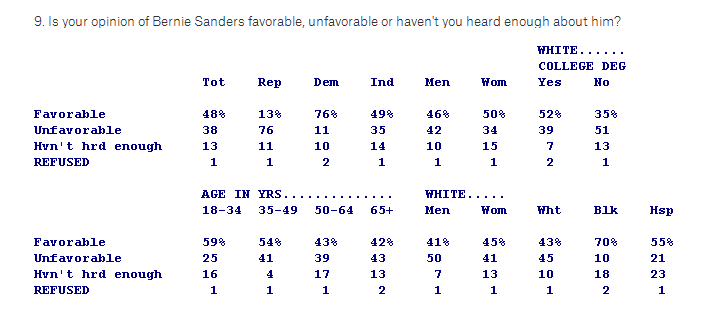
Here's a Gallup poll from Sept. 2018:

Here's a Harvard/Harris poll from last Nov. 2018:

Sanders' favorability among this-or-that group changes with time, margins of error vary, etc. but whatever the poll, these results are always the same: Sanders is overwhelmingly popular with people of color, far more popular with people of color than with white people, more popular with women than men. Sanders has taken the political "revolution" for which he called very seriously; he's been touring the U.S. almost constantly for 2 1/2 years on behalf of progressive causes and candidates, work that has seen he and the Our Revolution group he founded campaigning for large numbers of women and minority candidates. Among so many others, they threw their weight behind Randall Woodfin's ultimately successful "Putting People First" campaign for mayor of Birmingham, Chokwe Antar Lumumba also-successful bid for mayor of Jackson, Mississippi, Stacey Abrams' gubernatorial effort in Georgia (she won the Democratic nomination but was narrowly defeated in the general after Republicans pulled all kinds of shady fuckery), Andrew Gillum's campaign for Florida governor (Gillum went from 4th place in a 5-way race to a win the Dem primary after Sanders endorsed him, then narrowly lose the general), Rashida Tlaib's successful run for the U.S. House from Michigan--many, many others. Sanders has improved his standings, particularly from the days when he entered the last presidential race as a virtual unknown; it's there in all the polling data. Too many Clintonite commentators remain stuck in stale "identity" slanders.
A few days after her "Bernie has no real purchase" tweets (18 Dec.), Clara Jeffery was at it again, propagating another anti-Sanders fraud:

But the survey wasn't of "black women," nor was it a scientific poll or something that said anything about Bernie Sanders' prospects. Rather, a group called She the People just called up a few Democratic insiders who were women and asked for their opinions. Fewer than half of them were black. Nearly half of them (48.5%) were just big Dem donors, the people who corruptly purchase politicians and whom the progressives would put out of business. That a bunch of donors and Democratic insiders give Sanders poor marks is about as newsworthy a revelation as "water is wet." Jeffery's lies were corrected by multiple Twitter users almost as soon as she posted them but as of more than a month-and-a-half later, she has refused to take it down or correct it, while it is being shared thousands of times. The "journalist" that runs Mother Jones.
In December, a group of Sanders 2016 alumni circulated a letter privately seeking a meeting with Sanders and his top aides to "discuss the issue of sexual violence and harassment on the 2016 campaign, for the purpose of planning to mitigate the issue in the upcoming presidential cycle." Those great Bernie fans at Politico got their hands on it and published it under the headline, "Bernie Alumni Seek Meeting To Address 'Sexual Violence' on '16 Campaign" (30 Dec.) The letter was never meant to be made public. Some of the signatories were hopelessly naive:
"Several people who signed the letter said that their effort is not just about Sanders' 2016 or 2020 presidential campaigns, but rather about what they called a pervasive culture of toxic masculinity in the campaign world. They stressed that they hoped their letter would not be reduced to reinforcing the 'Bernie Bro' caricature, but rather would be part of a larger reckoning among people who run campaigns."Politico's Alex Thompson, however, was hopeful:
"Several members of Congress, Democrats and Republicans alike, resigned or announced their retirement in 2017 and 2018 in the wake of allegations about their own behavior or conduct of their top aides."Three days later, the New York Times picked up the story with a piece by Sydney Ember and Katie Benner, "Sexism Claims From Bernie Sanders’s 2016 Run: Paid Less, Treated Worse" (2 Jan.). The article reported there had been pay-disparities between men and women who worked on the campaign but said salaries were individually negotiated and that whenever any such disparities were brought to the attention of campaign higher-ups, they were corrected and the campaign then "conducted a review to try to standardize pay across the states and within headquarters." Other "women told of makeshift living accommodations on the road, where they were asked to sleep in rooms along with male co-workers they didn’t know." When this was "brought to the attention of senior leaders, including Mr. [Jeff] Weaver, the campaign manager, both Mr. Weaver and the chief operating officer 'ordered that staff never be housed in coed hotel rooms again.'" Really not much of a story there either. Much more serious are claims of some pretty outrageous sexual harassment that, unlike these other matters, weren't properly addressed.
"'I did experience sexual harassment during the campaign, and there was no one who would or could help,' said Samantha Davis, the former director of operations in Texas and New York, who also worked on the campaign’s advance team. She said that her supervisor marginalized her after she declined an invitation to his hotel room."Most of the problems detailed by the Times seem to have been centered in Sanders' Latino outreach team. Giulianna Di Lauro, who worked on it, describes some very inappropriate behavior toward her by a Mexican game-show host who was, at the time, acting as a surrogate for the campaign.
"When she reported the incident to Bill Velazquez, a manager on the Latino outreach team, he told her, 'I bet you would have liked it if he were younger,' according to her account and another woman who witnessed the exchange. Then he laughed."Velazquez, for his part, denied remembering that reaction and said he took the complaint seriously, assigned two women to keep an eye on the gameshow host for any further problems and sent the matter up the chain. Masha Mendieta reported in 2017 that Arturo Carmona, a manager on the Latino outreach team, had demeaned women and treated female staffers "like his personal assistants fetching things for him and doing his errands." In an interview with the Times, Mendieta said she complained about Carmona to her superiors multiple times "and was repeatedly ignored, at one point being told by Mr. Velazquez that she should forgive Mr. Carmona's behavior because he was 'macho.'"
The overall portrait of the campaign is of a thing that grew explosively, was very disorganized, personnel were inexperienced, inadequately trained (or screened), there were some bad apples in the barrel and these sorts of problems sometimes weren't adequately addressed. The Sanders camp stressed that it improved on these matters as things went along and later instituted improved protocols for Sanders 2018 Senate race. Sanders himself said he was unaware, during the campaign, of any sexual harassment, telling Anderson Cooper, "I certainly apologize to any woman who felt she was not treated appropriately, and of course if I run we will do better the next time." The Sanders camp made it clear no one involved in this sort of activity would be working for Sanders in the future.
The press rode the story for nearly 3 weeks.
Clara Jeffery reflected many an anti-Sanders pundits in getting in her licks over the matter, tweeting:
"Who would have guessed that a campaign that did nothing to speak against the sexist attacks of some of its most ardent/high profile followers--except half-hearted DM apologies--had rampant internal sexual discrimination problems as well?"In reality, of course, Sanders, confronted in 2016 by the "Bernie Bros" narrative concocted by the pro-Clinton press, was unequivocal on the matter of any sexist behavior:
"I have heard about it. It’s disgusting. Look, we don’t want that crap... We will do everything we can and I think we have tried. Look, anybody who is supporting me that is doing the sexist things is--we don’t want them. I don’t want them. That is not what this campaign is about."It was in response to rubbish like Jeffery's that Giulianna Di Lauro Velez wrote a piece for the Intercept, "I Was Sexually Harassed On Bernie Sanders's 2016 Campaign. I Will Not Be Weaponized Or Dismissed" in which she complained about the press treatment of the matter. While, she says, she told her story to bring attention to the "sexist environment that is unfortunately endemic to most workspaces, including political campaigns," she was
"disheartened to discover that the takeaway by many pundits was not that sexism and harassment is pervasive, but that Sanders was somehow uniquely culpable... As was the case throughout the 2016 campaign season, my personal experiences as a woman of color were sublimated to serve an establishment media narrative that pretends the progressive movement is all white, all male, and runs counter to the interests of women and people of color... [T]he corporate media unfairly focused on Sanders--casting the harassment that happened within his campaign much differently than similar cases with other campaigns--implicating his personal ethics in a way that they've declined to do with other politicians."She also wrote that some on the left had accused her and the other women who had spoken of sexual harassment on the campaign "of lying and wanting to purposefully attack the Vermont senator... Neoliberals and corporate media are unfair to Sanders and his supporters because our movement threatens their supremacy. But to dismiss our claims as mere bias is at best disingenuous and at worst cruel."
While the press was feeding on the sexual harassment allegations, the Barre-Montpelier Times Argus, a small but long-running newspaper in Vermont, ran an editorial, "Don't Run," which argued, "Bernie Sanders should not run for president. In fact, we beg him not to." Some of the highlights:
"We fear a Sanders run risks dividing the well-fractured Democratic Party, and could lead to another split in the 2020 presidential vote... As a candidate, Sanders is exhausting... [H]is personality is abrasive. He is known to be difficult to work with. The 77-year-old can be bombastic and prickly. He can be dismissive and rude in his arrogance."So a small paper in Sanders' own Vermont, one that endorsed Hillary Clinton over Sanders, trashes the senator. Big deal, right? Except--shocker of shockers!--it was treated as a big deal by a lot of the national corporate press, which, as it tends to do with anti-Sanders stories, picked up this one--if it can even be called a "story"--and amplified it a millionfold.
"Vermont Newspaper Editorial Board: 'We Beg' Bernie Sanders Not To Run In 2020", the Hill (6 Jan.)
"Editorial Board of Vermont Paper Begs Bernie Sanders Not To Run In 2020," Huffington Post (6 Jan.)
"Bernie Sanders Home State Paper Begs Him Not To Run For President," Roll Call (7 Jan.)
"Bernie Sanders Told Not To Run For President By Local Vermont Paper," Associated Press (7 Jan.)
"Bernie Sanders Asked Not To Run In 2020 By Vermont Newspaper, 'You Need To Know When To Step Out of the Way'," Newsweek (7 Jan.)
"Vermont Newspaper Begs Bernie Sanders 'Don't Run'," Washington Examiner (7 Jan.)
"Sen. Bernie Sanders Told By Local Paper Not To Run For President," Washington Times (7 Jan.)
"Bernie Sanders Shouldn't Run For President," Boston Globe (7 Jan.)
And on and on.
Years ago, David Brock was a major scumbag--as he described it, a hatchet-man for the right, a man who very sleazily dealt in sleaze for right-wing sleazeballs. He underwent a political awakening, became a liberal and launched Media Matters For America, a liberal watchdog devoted to correcting right-wing misinformation in media. For a few years, his became a story of an effort at redemption. Unfortunately, all his old, bad habits eventually crept back in, and he descended right back into the same sewer as before, except this time on behalf of Hillary Clinton and the Democratic Establishment. Among other things, he ran a network of online trolls in 2016 that attacked Clinton critics and openly coordinated with the Clinton campaign in the effort, in defiance of campaign finance laws.
It's absolutely astonishing--and a journalistic scandal--that any major news outlet would hire such a slimy, unethical bottom-feeder to author a prominent editorial--or anything else--but that's exactly what NBC did in January. The results are just as one would imagine. "Bernie Sanders Fans Can't Be Allowed To Poison Another Democratic Primary With Personal Attacks" (3 Jan.):
In Brock's presentation, everyone critical of O'Rourke is a "Berniecrat" or a "Bernie supporter." Brock tries and fails to present the criticism of O'Rourke as "flimsy and misleading" and asserts that, during his time in congress, "O'Rourke broke ranks with his party less than the average Democrat." Harry Enten, quoted earlier here, cites the reality of O'Rourke: "O'Rourke has voted more often with Trump than 80% of House Democrats." Brock tries to defend O'Rourke as a progressive, though--as noted earlier--O'Rourke himself has declined to call himself that.
"The real problem for Sanders' supporters," writes Brock, "seems to be that this 'Kennedyesque golden boy,' as one has derided O'Rourke, seems perfectly poised to steal Sanders' thunder among millennials and white liberals with his fresh energy and personal charisma." Another repetition of the "progressives are just a bunch of superficial idiots who will fall in behind a pol who doesn't share their views merely because he has a pretty smile" meme, but still nothing to support it. Brock says it's not enough for progressives "to disagree with O'Rourke; his persona and reputation must be dragged through the mud." But the progressives aren't saying O'Rourke cheats at cards or fools around on his wife. He's being criticized for his record, specifically, the parts with which progressives disagree. There's no way to wall that up and pretend it can't be criticized, particularly in a process aimed at sorting out a variety candidates.
Brock says Dems should view "this early maneuvering by Sanders supporters with alarm" and "ignore them at their own peril."
Brock offers this fanciful reimagining of the 2016 campaign:
It's absolutely astonishing--and a journalistic scandal--that any major news outlet would hire such a slimy, unethical bottom-feeder to author a prominent editorial--or anything else--but that's exactly what NBC did in January. The results are just as one would imagine. "Bernie Sanders Fans Can't Be Allowed To Poison Another Democratic Primary With Personal Attacks" (3 Jan.):
"I'm hardly the only political observer who blames Hillary Clinton's general election defeat to Donald Trump in part on personal attacks on Clinton first made by Sen. Bernie Sanders, I-Vt., and his backers. Those attacks from her left laid the groundwork for copycat attacks lobbed by Donald Trump..."The first big problem: Sanders never lobbed any "personal attacks" at Clinton. The things Brock tries to pawn off as such are legitimate criticisms of Clinton's record.[14] That Trump picked up on some of them--and did turn them into personal attacks--is neither any reflection on Sanders not in any way relevant to any evaluation of him. Continuing, Brock says those same "long knives... are out for are out for outgoing Rep. Beto O'Rourke, D-Texas, charging that he is not a true progressive." But the question of the extent of O'Rourke's devotion to progressive principles is, likewise, a question about O'Rourke's record, not a personal attack. Like so many writers on this subject, Brock has no evidence of a Sanders conspiracy but posits one anyway:
"The reason for these pre-emptive attacks (which has the markings of a coordinated effort) in a spate of news and opinion articles in a variety of publications, is obvious enough: After losing the Texas Senate race to incumbent Ted Cruz, O'Rourke nonetheless has shot to the top in Democratic primary polls since Election Day, overshadowing both Sanders and another left-wing favorite, Sen. Elizabeth Warren, D-Mass."In not a single Democratic primary poll--much less multiple polls--has O'Rourke ever finished at the top of the pack. He generally finishes in single digits. The "poll" to which Brock links to prove his assertion isn't a poll at all; it's an unscientific survey of MoveOn.org users. The only place O'Rourke was "overshadowing" Sanders and Warren was in press promotion.
In Brock's presentation, everyone critical of O'Rourke is a "Berniecrat" or a "Bernie supporter." Brock tries and fails to present the criticism of O'Rourke as "flimsy and misleading" and asserts that, during his time in congress, "O'Rourke broke ranks with his party less than the average Democrat." Harry Enten, quoted earlier here, cites the reality of O'Rourke: "O'Rourke has voted more often with Trump than 80% of House Democrats." Brock tries to defend O'Rourke as a progressive, though--as noted earlier--O'Rourke himself has declined to call himself that.
"The real problem for Sanders' supporters," writes Brock, "seems to be that this 'Kennedyesque golden boy,' as one has derided O'Rourke, seems perfectly poised to steal Sanders' thunder among millennials and white liberals with his fresh energy and personal charisma." Another repetition of the "progressives are just a bunch of superficial idiots who will fall in behind a pol who doesn't share their views merely because he has a pretty smile" meme, but still nothing to support it. Brock says it's not enough for progressives "to disagree with O'Rourke; his persona and reputation must be dragged through the mud." But the progressives aren't saying O'Rourke cheats at cards or fools around on his wife. He's being criticized for his record, specifically, the parts with which progressives disagree. There's no way to wall that up and pretend it can't be criticized, particularly in a process aimed at sorting out a variety candidates.
Brock says Dems should view "this early maneuvering by Sanders supporters with alarm" and "ignore them at their own peril."
"Failing to end this internecine warfare will mean that all members of the Democratic Party running for its presidential nomination will face months of minuscule ideological litmus tests turned into character assassinations."What, exactly, is the Democratic party to do to prevent criticism of Democratic presidential candidates? Brock doesn't say. No authoritarian mechanism of the sort he implies exists to do this, nor should anyone want such a thing. Brock hilariously says criticism of Dem candidates "driven by the far left" will be "lapped up by the press." Back on Planet Earth, the press is hostile to pretty much anything the progressives advance; in the case of O'Rourke, as covered here already, the press jumped in to attack the progressives, not to lap up what they were saying.
Brock offers this fanciful reimagining of the 2016 campaign:
"We've seen this movie before: Sanders' assault on Clinton's progressive credentials were pernicious in large part because they were not about policy disputes at all, but rather intended to falsely impugn Hillary's character and integrity."
While Clinton certainly tried to portray Sanders' criticism of the bribery-and-donor-service system as efforts to impugn Clinton's own "character and integrity"--as if Clinton ever had any such things--that criticism remains exactly what it was. Brock has to pick up Clinton's own bullshit narrative because he can't cite any examples of inappropriate personal attacks made on Clinton by Sanders. There weren't any
Brock writes, "the stakes are just too high to let bad faith actors--whose real aim is to smear Democrats as no different than Republicans--stage inter-party schisms." Again, the suggestion is that Dems should undertake some authoritarian effort to shut down criticism. Disingenuously, Brock writes that, "if Sanders decides to run again this time, he should focus on policy and eschew character attacks on Democrats--and admonish his supporters to do the same." With Brock pretending as if Sanders' policy focus in 2016 was really just character assassination, it's unclear what Sanders could do that wouldn't be so characterized by Brock.
Perhaps the best approach for Sanders and his supporters is to fail to worry themselves over the ravings of David Brock, even if NBC's ethical shortcomings do give him a platform.
--j.
---
[1] When it comes to individual progressive issues, that's more of a mixed bag. Media elites tend, for example, to be liberal on various social issues.
[2] The New York Times mostly ignored it as well--certainly didn't scandalize it--but as soon as party interference in Democratic primaries became an issue thanks to coverage in the left press, the paper did solicit Clintonite Elaine Kamarck to write an editorial defending this interference: "Actually, National Democrats Should Interfere In Primaries."
[3] In one of Biden's regular themes, he also takes credit for it, insisting he tried this first during his 1988 presidential campaign but was a bit ahead of his time. Biden likes to do that. He crowed about how he had authored portions of the horrible Clinton crime bill long before it passed, and how he'd created big portions of Bush's USA PATRIOT Act--such a glowing piece of legislation for which to take credit, eh?--well before Bush came to advocate it.
[4] Want to see a perhaps overly nitpicky but still on point observation? Other outlets picking up on this poll did mention Sanders and sometimes Elizabeth Warren (who was also beating Trump) but still gave Biden top billing:
--The Hill: "Poll: Trump Trails Biden, Sanders, Warren in Potential 2020 Matchups."
--The Washington Times: "Voters Prefer Joe Biden, Bernie Sanders Over Donald Trump In Hypothetical Matchups: Poll."
--The Daily Caller: "Poll Shows Trump Trails Biden, Sanders and Warren in Potential 2020 Match-Up."
[5] Sirota's colleague, Alex Kotch of Sludge, followed up, offering a detailed breakdown of Beto O'Rourke's oil and gas industry contributions. O'Rourke was a signatory of the No Fossil Fuel Money pledge created by Oil Change USA and a coalition of environmental groups; Kotch showed that he'd violated that pledge dozens of times and the org removed him from the list of signers. He also pointed out that Neera Tanden's Center for American Progress has also been financed by fossil fuel companies, which gives another perspective on her tantrum.
[6] As if to cover the other end, Allen and Seitz-Wald include this amusing comment:
"'Telling people that Beto O’Rouke is a moderate candidate is not going to do the damage that it would have before,' said one party elder who is not aligned with any of the candidates. 'They will strengthen him. They will make him into a bigger force than he is.'"Of course, if anyone actually believed that was remotely true, there wouldn't be the incredible fuss raised over criticism of O'Rourke; the Clintonites openly drooling over the prospect of an O'Rourke presidential campaign would just stand back, let the progressives say their peace and watch O'Rourke's stock rise. It's unclear why anyone would believe it's proper journalistic practice to grant anonymity to a source who is merely advancing a wholly ideological narrative then try to cover for him with the "not aligned with any of the candidates" line. He's clearly aligned with a particular species of candidate.
[7] The "Bernie Blackout" was an extension of this same attitude, an assertion that his campaign was so "not happenin'," it wasn't even worth covering.
[8] Except sometimes in the smaller left outlets.
[9] Among other things, this sets up an interesting dynamic for the next two years, as the corporate press, on the whole, remains just as opposed to progressive policies as ever and won't tolerate their propagation but, at the same time, the more conservative candidates the Dem Establishment-aligned elements of the press support have endorsed those same policies. Most of these candidates--let's just be honest--aren't at all serious about their newfound devotion to progressive policies--they say they back them merely to remain electorally viable--but what will CNN do when Kamala Harris, its current thrall, begins advocating Medicare For All healthcare reform, a policy against which CNN has crusaded for some time now? And what will she do in reaction to theirs? Stay tuned! This little piece of 2020 may get very interesting!
[10] The big Bernie fans at Politico introduced this theme of people who worked on Sanders' 2016 campaign not necessarily returning for a follow-up. Alex Thompson's "Bernie 2016 Alums Wary of 2020 Sequel" sought out as many people fitting that description as the journalist could find. His article touched on many of the other constant themes in the pour-cold-water-on-Sanders-2020 genre: he's a white guy and this is a problem, he's an old man and this is a problem, "Sanders is a victim of his own success"--an ubiquitous cliche in these stories--as all the other candidates have adopted parts of his agenda, and so on. "Enough fervent supporters... are wary of a 2020 run that it could be difficult to reignite the 2016 movement."
[11] Other than acknowledging 2020 "may be the most crowded, fractured and uncertain Democratic primary in the last quarter-century."
[12] Elizabeth Warren won the first of those Daily Kos "straw polls" in early January but Salon used it to bash Sanders. Matthew Rozsa wrote "New Poll Provides Big Boost For Elizabeth Warren," but only two lines into it, Rozsa decides the real story isn't the alleged good news for progressive Warren. Rather, "the most notable detail here," he writes, "is Sanders' poor showing." Sanders finished in a distant 5th place. "[A]s the runner up to Hillary Clinton from the 2016 presidential primaries, and a man who rejuvenated the Democratic Party's progressive base," Rozsa continues, "Sanders would have had good reason to anticipate dominating the Daily Kos poll." Good reason, perhaps, except for the fact that--as noted earlier--Sanders' supporters were purged from Daily Kos back in March 2016. This was done quite loudly and publicly and it entirely torpedoes the narrative Rozsa is advancing. It's hardly surprising Sanders doesn't do well in a survey of users of a site from which his supporters were, in effect, banned nearly 3 years ago. While Rozsa's comments may have just been a case of massive journalistic fail, Daily Kos itself was being entirely disingenuous in its evaluation, which Rozsa quotes:
"So who on that list above can do that? Warren, O’Rourke, Sanders, Booker, and Harris have already built that infrastructure. Bernie, however, has a 'yesterday’s news' feel to him. He has universal ID and the best he can manage is 11 percent on a site of Democratic activists? He can’t play the 'I'm more progressive than thou' card in this field, so he’s got nowhere to go but down, as other candidates become better known."Something else that's important: these aren't scientific polls. They're just Daily Kos users expressing their preference and have no more validity than the sort of phone-in surveys conducted by the likes of Lou Dobbs on Fox Business. Rozsa doesn't note this either.
[13] Democratic operative Sally Albright, one of the cruder idiots on the Clintonite right, has written that tuition-free higher education was racist and that "History will view the Bernie Sanders phenomenon as the death rattle of the last vestiges of white supremacy in the Democratic party." This was after 2016, so not strictly relevant to the strain of commentary of this breed that was going on at the time but Albright sucks and I just felt like throwing a spotlight on some of her idiocy.
[14] Brock tries to pull a fast one by quoting Sanders as saying, "I don't think you are qualified if you get $15 million from Wall Street through your super PAC."After losing Wisconsin, the Clinton camp launched a new campaign aimed at portraying Sanders as unqualified to be president. Sanders replied by turning that attack back on Clinton, which is the context of the quote Brock uses. The press then sent Clinton's effort to disqualify Sanders down a Memory Hole and bombarded the public with days of stories about how Sanders had portrayed Clinton as unqualified to be president. The whole sorry story can be read here.


